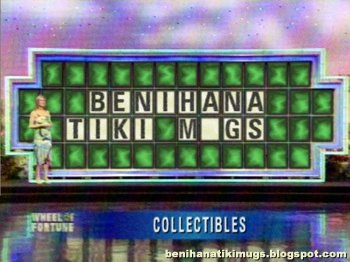
Welcome To The Benihana Tiki Mug Blog!

One of the enduring features at all of the many Benihana Restaurants is their use of many fun styles of white ceramic figural tiki mugs to serve their exotic cocktails, and, best of all, for just a few dollars more, after finishing their drink, guests can take their Benihana Tiki Mug home as a souvenir of their fun visit to Benihana!

As anyone who's a fan of tiki mugs knows (although purists would argue that these are not true tiki mugs because they don't depict actual tiki idols), these little white figural ceramic mugs have become highly collectible today, and this Benihana Tiki Mugs Blog hopes to be an informal, very un-scientific "museum" where fans and collectors alike can come and find out a little more information about these charming collectibles!

If you're still a little unsure about just what these are, or, if you've never even been to a Benihana Restaurant, and you're wondering just what the heck all the fuss is about, this fun little company video should explain it all very nicely! (TIP: Be sure to click the little square‑within‑a‑square icon in the bottom‑right corner of the video to get the full‑screen‑view effect!)


And, finally, if you do go to a Benihana, please, we're begging you, don't stick your chopsticks up your nose! Seriously, in researching and preparing this webpage, we have looked at literally hundreds of pictures taken in Benihana restaurants, and it's simply amazing how many of those snapshots show people with their chopsticks stuck up their nose! So, listen up, people, (and you know who you are), it's dumb, it's silly, you would never do that with a fork in an American restaurant, and it just makes you look like a big "baka gaijin" (stupid foreigner), so, cut it out already, OK? Oh, and another thing, don't do the Walrus Tusks, either. Trust us, that's just as dumb! Apparently, this problem is so wide-spread that one chopstick manufacturer has had to put a warning label on their wrappers!

Oh, well, in any case, these marvelous mugs are presented here in alphabetical order, and
Don't forget, just click on the pictures to see them bigger!


The Buddha Mug


Although there are several Benihana Tiki Mugs that are called Buddha mugs, often in error, we think that this one (and a minor variation of it without the fan-shaped halo) is the only one that is truly deserving of the name, because it depicts the real Siddhartha Gautama, also known as Gautama Buddha, the founder of Buddhism!

Buddha taught ethics and correct understanding, questioning the average person's notions of divinity and salvation, stating that even gods are subject to karma, too. He taught that the Buddah is not divine, but is solely a guide and teacher for sentient beings who must tread the path of Nirvana themselves to attain the spiritual awakening called Bodhi, and see truth and reality as it truly is.

So, get out your Buddha mug, fill it with an exotic rum-soaked cocktail, have a few sips, sit back, close your eyes, say "Om," and meditate on just how cool your enormous collection of Benihana Tiki Mugs is, dude!

[Photo]

The Canoe Boy Mug

Due to its odd shape, we guess, this fairly common Benihana Tiki Mug is usually called the Canoe Boy mug, but it is also known as the Rural Girl mug, too, and, in either case, it seems to depict a child wearing a woven bamboo head covering, perhaps a rain hat of some sort?

We think it's most likely that this mug is simply meant to celebrate "Children's Day," May 5th, which is a national holiday in Japan, a day on which families nationwide celebrate the happiness and healthy growth of children. On Children's Day, children often wave colorful streamers, called "koinobori," which are shaped like a carp fish, which is a symbol of strength and success in Japanese culture.

There's also an alternate version that depicts the same child, but holding a dolly and a lolly — pop, plus, there's yet another version that has the child holding a paper lantern, with a little brother or sister tucked under their arm, and some of those have a pale pink, yellow, blue or green glaze covering them, and are made by the legendary McCoy Pottery company!

The Chef Mug

This cartoonish little cutie is a Benihana Tiki Mug of a Benihana Chef!

Benihana's highly-skilled teppanyaki chefs slice and dice, and toss and shake your meal in such a way as to "eatertain" you while you're enjoying traditional Japanese cooking using American favorites like steak, chicken, seafood and vegetables. Benihana pioneered the communal dining concept in the early 1960's where up to eight people are seated around a steel hibachi grill table waiting anxiously for their personal show to begin. Currently, Benihana holds the record for the longest-running dinner show in the world!

For some reason this mug is commonly referred to as the Magic Chef mug, and there is one variation of this mug, a more realistic-looking Standing Chef mug, and it looks to us like he'd hold more drink than this cartoonish one, which would make him the better deal, drink-wise!

UPDATE: Hey, get this, the Magic Chef is now a celebrity! Yes, it's true, we recently spotted one of these Chef mugs listed on eBay as having been used as a prop on the Reba television show! Way to go, little chef dude! Gee, we hope this doesn't go to his enormous head — next thing you know, he's going to want his own cooking show on the Food Channel!

The Daikoku Mug

Most often referred to as "the little guy with the hammer," or sometimes, because of the sack he carries on his back, "Santa Claus," this is, in fact, Daikoku, who is yet another of the famed Seven Lucky Gods (Shichifukujin) who have been immortalized as Benihana Tiki Mugs.

Images of Daikoku are found in the temples of Tibet and China, and he enjoys an exalted position as a household deity in Japan, where Daikoku is variously considered to be the god of wealth, or of the household, particularly the kitchen.

Daikoku's association with wealth and prosperity gave rise to an odd Japanese custom known as Fuku-nusubi, where folks believe that he who steals divine figurines of gods and goddesses, is assured of good fortune, but only if not caught in the act of stealing! Which is kind of like how some folks treat garden gnomes here in the U.S.A., when you think about it.

There are a few variations of the Daikoku mug available: he's often seen sitting (or standing) on two bales of rice, and is frequently found covered in a dark-brown glaze, too!

The Daruma Mug

Another very popular style of Benihana Tiki Mug is the Daruma mug, which is usually mistakenly called a Buddha mug or, occasionally, an angry troll.

In actual fact, Daruma is a depiction of Bodhidharma, a fifth-century Buddhist monk, the father of Zen Buddhism in China and Japan, who, it is said, meditated in a seated position non-stop for nine years and, as a consequence, his arms and legs and eyelids atrophied and fell off! Some versions of the story say that he dozed off while meditating, and cut off his own eyelids in anger, which then fell to the ground and sprouted into China's first green tea plants!

In either case, this is why the Daruma Doll (and mug), is always pictured as just a wide-eyed disembodied head! Daruma Dolls are very popular in Japan, where they are colorful "wishing" dolls, with blank eyes. The owner buys a doll and colors in one eye and makes a wish. Then, when the wish comes true, they color in the other eye, too!

The Daruma mug is commonly seen in three styles, this one, or an alternate version that's found either with or without a rope headband, although that "alternate" version looks so very different that, frankly, we think it's possible that it may depict some other Japanese deity entirely... or not.

The Dragon Mug

Arguably the rarest of all the Benihana Tiki Mugs is the legendary Dragon mug, most likely made to celebrate The Year Of The Dragon, which would mean that these were probably made in either 1964, 1976, 1988 or 2000, all Dragon years.

Some say that there were only one dozen of these rare mugs made for Benihana founder Rocky Aoki's exclusive personal use, and that when they were finished, the molds used to make them were burned in a sacred midnight ceremony on a night when the Moon was in the Seventh House, and Jupiter aligned with Mars.

That's total hogwash, actually, we made it all up, but the Dragon mug is, in fact, quite rare, only showing up on eBay once a year or so and usually selling for nearly a hundred bucks when it does! So, if you spot one of these at a yard sale, do try to contain your unbridled joy as you fork over a dollar or two for it, for you've struck Benihana Tiki Mug gold, my friend!

(Don't forget, just click the pics to see them bigger!)

The Foo Dog Mug

Recently spotted on eBay, where it sold for an amazing $145, this unusual Benihana Tiki Mug depicts a Foo Dog or, more properly, a Chinese Guardian Lion, after which the many various Foo Dog breeds, like the Pekinese, etc. are named.

It has also been suggested to us by this mug's proud new owner, longtime collector Henry R., that it may be meant to represent The Year Of The Dog, which, considering that there are also mugs for The Year Of The Dragon, Snake and Rabbit, too, is entirely possible!

In any case, Foo Dogs are mythical beasts commonly found at temple, tomb or garden entrances, where they perform a gargoyle's task of protecting buildings against evil spirits, and even the Forbidden City in Beijing, China, is guarded by Foo Dogs! Usually carved from stone, they are most commonly shown standing guard with teeth bared, discouraging evil spirits and wrong doers from entering. The Foo Dog with an open mouth sucks in all evil spirits, while the closed mouth dog keeps them contained, and males are usually depicted with a paw on a sphere, while females have their paw on a puppy! They are also known as the Happiness Dog, as well as the Celestial Dog, an ultimate emblem of value and energy and strength.

We've certainly never, ever, seen one of these mugs before, and its recent sale price of $145, may be a record-setting price for a Benihana Tiki Mug on eBay. (We're told that the seller picked it up in a Goodwill store for $2.99!) In any case, we think it's safe to say that these are rare — very rare — rarer, even, than the legendary Dragon Mug (seen above), which was previously thought to be the rarest of all the Benihana Tiki Mugs!

The Fu Manchu Mug

OK, this scary Benihana Tiki Mug is the Fu Manchu mug, and frankly, never having seen it before, we can only assume that it's a rather rare one.

Dr. Fu Manchu is an evil master criminal who is a fictional character first featured in a series of novels by English author Sax Rohmer during the first half of the 20th century. FuManchu was also featured extensively in cinema, television, radio, comic strips, and comic books for over 90 years, and has become an archetype of the evil criminal genius while simultaneously inspiring the famed Fu Manchu mustache!

All in all, Fu Manchu was an extremely nasty piece of work and, well, frankly, we're really kinda surprised that he's been immortalized as a Benihana Tiki Mug to be used while having a nice dinner on a pleasant evening out with the family:

"Happy Birthday, Grandma, here's your drink."
"Aaaaaaghh!! Take it away, take it away!!"

The Geisha Mug

Geisha Girls are very popular in films and popular culture, and they're very popular in Benihana Tiki Mugs, too! (Hey, I just used the word "popular" three times in that sentence... I guess it's a popular word, huh? Oops, I did it again!)

There are several variations on the Geisha Girl theme in the world of mugs; there's the Standing Geisha, our favorite, seen in the photo, plus there's also the Kneeling Geisha, and the Parasol Geisha, who carries one of those little paper drink parasols on her shoulder, as well as the Dynasty Geisha, made, not surprisingly, by the "Dynasty" pottery company, and there's another variation or two on the Standing Geisha, as well! Plus, we've just been told of yet another rather rare variation of the Kneeling Geisha who's seen playing a Shamisen, which is a sort of Japanese ukulele, or lute.

So, the Geisha Girl theme seems to be quite popular (uh, oh, there's that word again) in the world of Benihana Tiki Mugs, but, as with the Hotei mug, their very popularity means that, sadly, these girls aren't really worth much, just few bucks at yard sales and flea markets.

Well, they may be cheap, but they ain't easy — contrary to popular (oh, no, not again!) western belief, in real-life it seems Geishas are not prostitutes after all! In fact, gei means "of the arts" and sha means "person" so the word geisha literally means "a person of the arts," and it turns out they're not hookers, they're "artistes!" Go figure!

The Hotei Mug

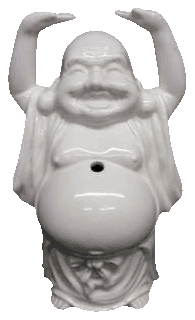
Beyond a doubt, the most famous and most popular, and certainly the most iconic, of all of the twenty or so different styles of Benihana Tiki Mugs has got to be the famous Hotei mug!

Also known as the Laughing Buddha mug, it depicts Hotei (or Ho Tai), also called Budai, who, interestingly, is one of the famous Seven Lucky Gods (Shichifukujin), and is the Bodhisattva Maitreya, the predicted Buddha to succeed the original, Gautama Buddha, in the future.

Being as popular as he is, there's probably about a dozen or so different variations of this one mug alone (some show him with his arms down, or seated, and every now and then he even turns up covered in a brown glaze, too), and, of course, the downside of his being that popular is the fact that, sadly, they're really not worth all that much, usually being found in thrift shops, flea markets and yard sales for just a few bucks!

He's still our favorite, though! How could you not love that chubby little guy, with his laughing face, rotund belly and his cute "raise the roof" dance-move posture?

The Jurojin Mug

This old dude is Jurojin, also known as Fukurokuju, who is yet another of the famed Seven Lucky Gods (Shichifukujin), that have been immortalized as Benihana Tiki Mugs!

He is the god of longevity, and is commonly depicted carrying a fan and a staff, with a scroll tied to the staff, on which is written the lifespan of all living things.

There are a few variations of the Jurojin mug: he's sometimes seen with or without his fan, and there's also another version where he's looking rather ominous wrapped in a long cloak, too. Plus, we've recently been informed by a sharp-eyed reader that our "Shennong Mug," seen below, may be, in actual fact, just another variation of the "Jurojin Mug" after all!

The Kendo Mug

Usually mis-identified as a Samurai, this very distinctive Benihana Tiki Mug depicts a modern-day practitioner of Kendo, which is the Japanese martial art of fencing. These Kendo mugs are fairly rare, and are even rarer still when found with its bamboo sword intact!

Kendo means "The Way of the Sword," and it traces its roots to medieval Japan, at which time swordsmanship flourished. Kendo players engage in strenuous matches to develop courage, rapid reflexes, clarity of thought, concentration and self-discipline.

Kendo is practiced wearing protective armour, bogu,, using one or two bamboo swords, shinai, as weapons. Kendo training is also rather noisy in comparison to other martial arts, because when a strike or cut is performed, players use a shout, or kiai, to express their spirit, and their front foot contacts the floor in a loud stamping motion, called fumikomi-ashi.

It is said that the object of Kendo is not to dominate others, but to master oneself, Grasshopper.

The Kokeshi Mug

This charming Benihana Tiki Mug is the Kokeshi mug, depicting a traditional Japanese doll, and they're fairly rare. The last one we saw sell on eBay went for $81 bucks, so if you spot one in a thrift shop or at a yard sale, grab it!!

Traditional Kokeshi dolls date back to approximately two hundred years ago, sometime in the middle of the Edo period. They were first produced in the north-east area of Japan known as the Tohoku region, and it is commonly thought that woodworking artisans of the time, known as Kijiya, who specialized in wooden household utensils such as trays and bowls, began to make small dolls in the winter to sell to the tourists who came to bathe in the many hot springs near their villages.

The few people who could afford the luxury of such a vacation pastime bought Kokeshi dolls as souvenirs and took them back to their homes where they were given to the children. This, they thought, would promise a good harvest, as it was believed that it would create a positive impression with the gods if the children played with the dolls.

(Don't forget, just click the pics to see them bigger!)

The Kumamoto Mug

This rather odd Benihana Tiki Mug depicts the famed Kumamoto Castle in Japan.

A popular tourist destination today, Kumamoto Castle was constructed by the Kato Clan in 1607. Half a century later, it was handed over to the Hosokawa Clan, who ruled the surrounding fief from there for over 200 years until the end of the feudal age. In 1877, Kumamoto Castle became the site of Japan's last civil war. Large parts of the castle were destroyed in that conflict, so most of the present castle buildings, including the large and small castle towers, are reconstructions dating from the 1960s, and the interior of the castle towers is now a modern museum.

These mugs turn up on eBay a few times a year, so they're not too rare, although the last one we saw there sold for almost $50 bucks! Interestingly, when you consider that every other mug on this page depicts a person or an animal, either living or fictional, the Kumamoto Castle mug is certainly "the exception to the rule," as they say!


The Kwan Yin Mug


This beautiful, and very rare, Benihana Tiki Mug depicts Kwan Yin, beloved goddess of over a billion people all over the world!

A fascinating goddess, Kwan Yin is, in fact, the Chinese version of the male Indian god Avalokiteshvara, and she is the goddess of compassion, venerated by East Asian Buddhists for her efforts to free all sentient beings from samsara, or reincarnation. The name Kwan Yin, or Guanyin, is short for Guanshiyin, which means, "One Who Hears The Cries Of The World."

We're very grateful to avid Benihana Tiki Mug collector, Anitra B., a long-time fan of this website, for bringing this divine, and very rare, mug to our attention. We'd never seen this one before, and she tells us that, incredibly, she actually found two of them... one in a Goodwill store, and then another in a garage sale, for, get this, 50 cents!

So, I don't know about you, but Anitra's fortunate finds have certainly renewed my dedication to the Goodwill store and garage sale search for these little treasures. Happy hunting!


The Maneki Neko Mug

This charming Benihana Tiki Mug shows Maneki Neko the Japanese good luck, fortune, money cat!

Maneki Neko (literally "beckoning cat") is a very common Japanese good luck figurine, usually made of porcelain or ceramic, which is believed to bring great fortune to its owner. The figurine depicts a cat (traditionally a Japanese Bobtail) beckoning with an upright paw, and is usually displayed at the entrance of shops, restaurants, pachinko parlors, and other businesses. It is believed that a raised right paw attracts money, while a raised left paw attracts customers.

[Sushi Cat Photo]The story behind this unusual cat and his odd pose is that once upon a time a nobleman passed by a temple on a stormy day and spied a cat that was sitting in front and seemed to be beckoning to him. Taking the cat's unusual gesture as an omen, the nobleman stopped and went into the temple, and when he did, a bolt of lightning struck the ground exactly where he had been standing! In gratitude, he bestowed a small fortune upon the cat and the modest temple it lived in. Since that time, cats have been considered very lucky spirits in Japan, and many shops and homes display the Maneki Neko figurine of a cat with one paw raised as if waving or beckoning.

The only variations of this Lucky Cat Benihana Tiki Mug that we know of are a version where the cat has his left paw raised instead of his right, and his medallion coin is round instead of oval, plus there's another rather rare version that has painted-in eyes, and a coin with a Benihana logo on it! Interestingly, the expression, "give a gold coin to a cat," is the Japanese equivalent of our "pearls before swine."

The Mayan Mug

Well, we thought we'd seen it all, every Benihana Tiki Mug ever made, and then, one sunny afternoon, much to our delight, we spotted this marvelous Mayan Mug listed for sale on eBay!

According to the printing on the back, it comes from one of the many restaurants at the Acapulco Hyatt Regency hotel in Mexico, so, technically, since it doesn't come from a Benihana, or any other Japanese restaurant, for that matter, we suppose it's not really a "true" Benihana Tiki Mug, but, heck, it's definitely a winner, and we're definitely very pleased to add it to this blog!

The Mayans were a pre-Aztec and pre-Inca Meso-American civilization, noted for the only known written language of the pre-Columbian Americas, as well as their spectacular artworks, monumental architecture and sophisticated mathematical and astronomical systems. They were also known for their incredibly accurate calendar, which thousands of people now believe predicts that the world will end on December 21, 2012!

And, considering the fact that the Mayans also had a predilection for human sacrifice, too, it might not be such a good idea to order a "Bloody Mary" in one of these mugs, if you know what we mean!

The Ninja Mug

This striking Benihana Tiki Mug depicts a Ninja with his little ceramic sword, which goes in a scabbard on his back, at his feet.

A Ninja is someone specially trained in a variety of unorthodox arts of war, usually trained for dangerous missions. Their exact origins are still unknown, but their roles may have included sabotage, espionage, assassination missions, and a variety of martial arts, as a way to destabilize and cause social chaos in enemy territory or against an opposing ruler, perhaps in the service of their feudal rulers, or an underground ninja organization waging guerilla warfare.

It's rather rare to find one of these with his little ceramic sword still present and intact. There are also a couple of variatons on the Ninja theme: there's a slightly different kneeling version, plus there's a standing version made by Dynasty, too!

The Noh Mug

Often mis-identified as a Kabuki mug, and sometimes mistakenly called a Ghost mug, this unusual, and rather rare, Benihana Tiki Mug actually depicts an actor in a Noh play, or Japanese opera.

Different from other forms of Japanese theater mainly because of its use of beautiful, exotic masks, Noh is a major form of classic Japanese musical drama that has been performed since the 14th century and is now, in the present day, registered as an Intangible Cultural Heritage by UNESCO. It is a unique theatrical art in Japan, and is credited as the oldest performance art in the world- musical theater which involves not only acting but also dance and vocal music, too.

These exotic Benihana Tiki Mugs are quite rare, and there is at least one variation out there of a similarly-robed actor in a different pose.

Hey, we hear they recently named a street in Japan after this ancient traditional style of theater, and it's called — wait for it — "Noh Way!"

The Rabbit Mug

Rabbits ("usagi" in Japanese) are hugely popular in Japan, where they are always connected with the moon. It is said that, to the Japanese, the dark and light shapes of the full moon looks like a rabbit who is making rice cakes!

And so, we think that the rarely-seen Rabbit mug is meant to celebrate The Year Of The Rabbit which means it was probably made in 1975, 1987 or 1999, all of which were Rabbit years.

They say that those born in the The Year Of The Rabbit (and, when figuring it out, don't forget that the Chinese New Year is in February), are articulate, talented, and ambitious. They are virtuous, reserved, and have excellent taste. Rabbit people are admired, trusted, are often financially lucky, and they are most compatible with those born in the years of the Sheep, the Boar, and the Dog.

Since we've never seen one of these Benihana Tiki Mugs before, we have to assume they're quite rare, and the last one sold on eBay (in a lot with a few other common ones) went for $75 bucks!!

(Don't forget, just click the pics to see them bigger!)

The Safflower "Mug"

[Safflower Mug-Vase Photo]
OK, let's get this over with once and for all, this is not, we repeat, NOT, a Benihana Tiki Mug, it's a vase!!

Here's the story: Right after the Second World War, Benihana founder Rocky Aoki's father, Yunosuke Aoki, a samurai descendant and a popular Japanese entertainer, together with his wife Katsu, opened a small coffee shop in Tokyo, and a red safflower found growing in the neighborhood streets gave the Aoki's the inspiration for the restaurant's name: Benihana, which in Japanese means "red flower." Today, that red safflower is used as the Benihana Restaurant chain's corporate logo, and that logo has been immortalized as flower vases that are used as table decorations in the restaurants.

Oddly enough, these are made in Peru, of all places, and, because they have the word Benihana on them, we see them mistakenly listed on eBay as Benihana Tiki Mugs all the time, so we just want to go on the record here to state: no, it is NOT a mug, it's a vase! The funny thing is that while the real mugs are often mistakenly called a vase, this one, which is a real vase, is often mistakenly called a mug! Go figure!

The Samurai Mug

Here's a Benihana Tiki Mug of a fierce-looking Samurai Warrior in full battle armor!

The Samurai, or bushi, were the members of the military class, the Japanese warriors. The Samurai employed a wide range of weapons such as bows and arrows, spears and guns; but their most famous weapon, and the symbol by which they are best known, was the sword, or katana. The Samurai were supposed to lead their lives according to the ethics code known as The Way Of The Warrior, or Bushido. Strongly Confucian in nature, Bushido stressed concepts such as loyalty to one's master, self discipline and respectful, ethical behavior.

There are a few other versions of these Samurai mugs available: there's another armored standing version, plus, dressed far less fearsomely in simple kimonos, there's also a kneeling version with a sword, and a seated version with a fan, which is sometimes seen covered with a golden-brown glaze.

Plus, there's also a rather odd-looking mug, usually glazed dark-brown, of just the helmet that you see him wearing in the picture, and one of those was recently sold on eBay for over $40!

The Schoolgirl Mug

Well, we spotted this interesting mug on eBay a few days ago, and, never having seen it before, we have to admit, this one has us totally stumped as to what it is!

The seller was no help at all, so we asked a bunch of friends, neighbors and family members what they thought it might be, and the most popular answer was "Schoolgirl," followed closely by "Housewife," "I don't know," and "Leave me alone!"

So, since we really don't know what else to call it, and based on our very informal survey, we proudly present the Benihana Tiki Mugs Blog's latest acquisition, The Schoolgirl Mug?

If this mug is, in fact, a schoolgirl, then, like the Canoe Boy mug, seen above, it's probably meant to celebrate "Children's Day," May 5th, which is a national holiday in Japan, a day on which families nationwide celebrate the happiness and healthy growth of children.

All we've been able to find out about it is that it has no markings on it, other than a red paper label on the bottom, reading "Made In China," so at least we know it's not marked Benihana, and, other than that, the only other thing we can tell you is that it sold on eBay for $40 bucks, which ain't too shabby for a Benihana Tiki Mug!

Or, if you have a better idea what this mug might represent, we'd sure love to hear from you, so, please use the email link at the upper-right of this page to send us an email and put us out of our misery, OK?

UPDATE: At last, the truth has been revealed! Reader Rachel N. wrote in to tell us the true story of this mug, and here's what she wrote: "I just thought you might like to know that the 'schoolgirl' mug is actually a depiction of a traditional Japanese bride! The clear give-away is her head-gear. Click here to see a picture."

UPDATE II: Since we wrote all of the above, we've also recently spotted a variation of what we now know to be the Bride Mug, which is a mug of a kneeling Japanese Woman or housewife. So, together with the Bride Mug, the pair of them sort of make an amusing "before and after" picture of marriage!